Monitor your self-hosted Apache Kafka cluster by installing the OpenTelemetry Collector directly on Linux hosts. Choose between the OpenTelemetry Java agent or Prometheus JMX Exporter approach to collect JMX metrics from your Kafka brokers.
Architecture
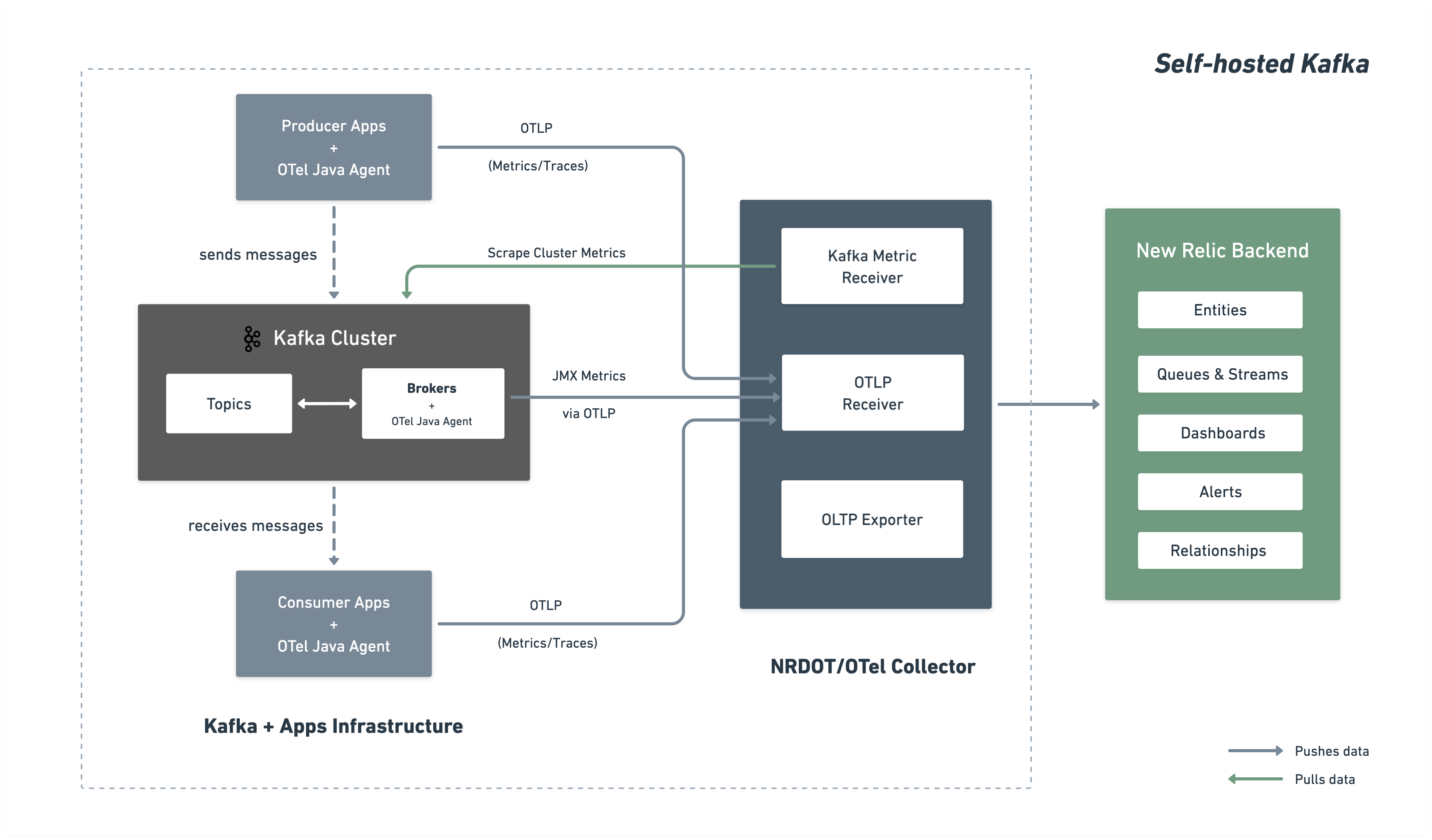
New Relic supports two approaches for monitoring self-hosted Kafka: the OpenTelemetry Java agent or the Prometheus JMX Exporter. The following diagram illustrates the data flow for each approach.
Installation steps
Follow these steps to set up comprehensive Kafka monitoring by installing the OpenTelemetry Java agent on your brokers and deploying a collector to gather and send metrics and logs to New Relic.
Before you begin
Ensure you have:
- A New Relic account with a
- Network access from the collector to Kafka bootstrap server port (typically 9092)
Create collector configuration
Create the main OpenTelemetry Collector configuration at ~/opentelemetry/collector-kafka-config.yaml on a monitoring host.
receivers: # OTLP receiver for Kafka and JMX metrics from Java agents and application telemetry otlp: protocols: grpc: endpoint: "0.0.0.0:4317"
# Kafka metrics receiver for cluster-level metrics kafkametrics: brokers: ${env:KAFKA_BOOTSTRAP_BROKER_ADDRESSES} protocol_version: 2.0.0 scrapers: - brokers - topics - consumers collection_interval: 30s # Exclude internal Kafka topics (prefixed with __) at the source topic_match: "^[^_].*$" metrics: kafka.topic.min_insync_replicas: enabled: true kafka.topic.replication_factor: enabled: true kafka.partition.replicas: enabled: false kafka.partition.oldest_offset: enabled: false kafka.partition.current_offset: enabled: false
processors: batch/aggregation: send_batch_size: 1024 timeout: 30s
resourcedetection: detectors: [env, ec2, system] system: resource_attributes: host.name: enabled: true host.id: enabled: true
resource: attributes: - action: insert key: kafka.cluster.name value: ${env:KAFKA_CLUSTER_NAME}
transform/remove_broker_id: metric_statements: # Remove broker.id for cluster-level metrics — these represent the whole cluster, # not a specific broker. broker.id is retained on broker-level metrics pipelines. - context: resource statements: - delete_key(attributes, "broker.id")
transform/remove_extra_attributes: metric_statements: - context: resource statements: # Delete all attributes starting with "process." - delete_matching_keys(attributes, "^process\\..*") # Delete all attributes starting with "telemetry." - delete_matching_keys(attributes, "^telemetry\\..*") - delete_key(attributes, "host.arch") - delete_key(attributes, "os.description") - delete_key(attributes, "host.image.id") - delete_key(attributes, "host.type") - delete_matching_keys(attributes, "^cloud\\..*") - delete_key(attributes, "service.instance.id") where IsMatch(attributes["service.name"], "^unknown_service:") - delete_key(attributes, "service.name") where IsMatch(attributes["service.name"], "^unknown_service:")
# Filter internal Kafka topics as a safety net (kafkametrics topic_match handles the receiver side) filter/internal_topics: metrics: datapoint: - 'attributes["topic"] != nil and IsMatch(attributes["topic"], "^__.*")'
filter/include_cluster_metrics: metrics: include: match_type: regexp metric_names: - "kafka\\.partition\\.offline" - "kafka\\.(leader|unclean)\\.election\\.rate" - "kafka\\.partition\\.non_preferred_leader" - "kafka\\.broker\\.fenced\\.count" - "kafka\\.cluster\\.partition\\.count" - "kafka\\.cluster\\.topic\\.count"
filter/exclude_cluster_metrics: metrics: exclude: match_type: regexp metric_names: - "kafka\\.partition\\.offline" - "kafka\\.(leader|unclean)\\.election\\.rate" - "kafka\\.partition\\.non_preferred_leader" - "kafka\\.broker\\.fenced\\.count" - "kafka\\.cluster\\.partition\\.count" - "kafka\\.cluster\\.topic\\.count"
transform/des_units: metric_statements: - context: metric statements: - set(description, "") where description != "" - set(unit, "") where unit != ""
cumulativetodelta:
metricstransform/kafka_topic_sum_aggregation: transforms: - include: kafka.partition.replicas_in_sync action: insert new_name: kafka.partition.replicas_in_sync.total operations: - action: aggregate_labels label_set: [topic] aggregation_type: sum
- include: kafka.partition.replicas action: insert new_name: kafka.partition.replicas.total operations: - action: aggregate_labels label_set: [topic] aggregation_type: sum
filter/remove_partition_level_replicas: metrics: exclude: match_type: strict metric_names: - kafka.partition.replicas_in_sync
groupbyattrs/cluster: keys: [kafka.cluster.name]
metricstransform/cluster_max: transforms: - include: "kafka\\.partition\\.offline|kafka\\.leader\\.election\\.rate|kafka\\.unclean\\.election\\.rate|kafka\\.partition\\.non_preferred_leader|kafka\\.broker\\.fenced\\.count|kafka\\.cluster\\.partition\\.count|kafka\\.cluster\\.topic\\.count" match_type: regexp action: update operations: - action: aggregate_labels aggregation_type: max label_set: []
exporters: otlp/newrelic: endpoint: ${env:NEW_RELIC_OTLP_ENDPOINT} headers: api-key: ${env:NEW_RELIC_LICENSE_KEY} compression: gzip timeout: 30s
service: pipelines: # Broker metrics pipeline (excludes cluster-level metrics) metrics/broker: receivers: [otlp, kafkametrics] processors: - resourcedetection - resource - filter/exclude_cluster_metrics - filter/internal_topics - transform/remove_extra_attributes - transform/des_units - cumulativetodelta - metricstransform/kafka_topic_sum_aggregation - filter/remove_partition_level_replicas - batch/aggregation exporters: [otlp/newrelic]
# Cluster metrics pipeline (controller-emitted metrics like offline partitions, topic/partition counts — no broker.id) metrics/cluster: receivers: [otlp] processors: - resourcedetection - resource - filter/include_cluster_metrics - transform/remove_broker_id - transform/remove_extra_attributes - transform/des_units - cumulativetodelta - groupbyattrs/cluster - metricstransform/cluster_max - batch/aggregation exporters: [otlp/newrelic]
# APM traces pipeline (producer + consumer spans via OTel Java agent) traces/apps: receivers: [otlp] processors: [resourcedetection, resource, batch/aggregation] exporters: [otlp/newrelic]
# APM logs pipeline (producer + consumer logs via OTel Java agent) logs/apps: receivers: [otlp] processors: [resourcedetection, resource, batch/aggregation] exporters: [otlp/newrelic]Set environment variables
Set the required environment variables on the monitoring host before installing the collector:
$export NEW_RELIC_LICENSE_KEY="YOUR_LICENSE_KEY"$export KAFKA_CLUSTER_NAME="my-kafka-cluster"$export KAFKA_BOOTSTRAP_BROKER_ADDRESSES="broker1-host:9092,broker2-host:9092,broker3-host:9092"$export NEW_RELIC_OTLP_ENDPOINT="https://otlp.nr-data.net:4317" # US region$# EU region: https://otlp.eu01.nr-data.net:4317$# JP region: https://otlp.jp.nr-data.net:4317Configuration parameters
The following table describes the key configuration parameters:
| Variable | Description |
|---|---|
NEW_RELIC_LICENSE_KEY | Your New Relic license key, for example YOUR_LICENSE_KEY |
KAFKA_CLUSTER_NAME | A unique name for your Kafka cluster, for example my-kafka-cluster |
KAFKA_BOOTSTRAP_BROKER_ADDRESSES | Your Kafka bootstrap broker addresses, for example broker1-host:9092,broker2-host:9092,broker3-host:9092 |
NEW_RELIC_OTLP_ENDPOINT | OTLP ingest endpoint. Use https://otlp.nr-data.net:4317 for the US region, https://otlp.eu01.nr-data.net:4317 for the EU region, or https://otlp.jp.nr-data.net:4317 for the JP region. For other configurations, see Configure your OTLP endpoint. |
Install and start the collector
Install and run the collector on the monitoring host. Choose between NRDOT Collector (New Relic's distribution) or OpenTelemetry Collector:
Tip
NRDOT Collector is New Relic's distribution of OpenTelemetry Collector with New Relic support for assistance.
Step 1. Download and install the binary
Download and install the NRDOT Collector binary for your host operating system. The example below is for linux_amd64 architecture:
$# Set version and architecture$NRDOT_VERSION="1.9.0"$ARCH="amd64"  # or arm64$
$# Download and extract$curl "https://github.com/newrelic/nrdot-collector-releases/releases/download/${NRDOT_VERSION}/nrdot-collector_${NRDOT_VERSION}_linux_${ARCH}.tar.gz" \>  --location --output collector.tar.gz$tar -xzf collector.tar.gz$
$# Move to a location in PATH (optional)$sudo mv nrdot-collector /usr/local/bin/$
$# Verify installation$nrdot-collector --version
Important
For other operating systems and architectures, visit NRDOT Collector releases and download the appropriate binary for your system.
Step 2. Start the collector
Run the collector with your configuration file to begin monitoring:
$nrdot-collector --config ~/opentelemetry/collector-kafka-config.yamlThe collector is now running and ready to receive data. Complete the remaining steps to attach the Java agent to your Kafka brokers before metrics appear in New Relic.
Step 1. Download and install the binary
Download and install the OpenTelemetry Collector Contrib binary for your host operating system. The example below is for linux_amd64 architecture:
$# Set version and architecture$# Check https://github.com/open-telemetry/opentelemetry-collector-releases/releases/latest for the latest version$OTEL_VERSION="<collector_version>"$ARCH="amd64"$
$# Download the collector$curl -L -o otelcol-contrib.tar.gz \>  "https://github.com/open-telemetry/opentelemetry-collector-releases/releases/download/v${OTEL_VERSION}/otelcol-contrib_${OTEL_VERSION}_linux_${ARCH}.tar.gz"$
$# Extract the binary$tar -xzf otelcol-contrib.tar.gz$
$# Move to a location in PATH (optional)$sudo mv otelcol-contrib /usr/local/bin/$
$# Verify installation$otelcol-contrib --version
For other operating systems, visit the OpenTelemetry Collector releases page.
Step 2. Start the collector
Run the collector with your configuration file to begin monitoring:
$otelcol-contrib --config ~/opentelemetry/collector-kafka-config.yamlThe collector is now running and ready to receive data. Complete the remaining steps to attach the Java agent to your Kafka brokers before metrics appear in New Relic.
Download the OpenTelemetry Java agent
Important
Ensure your OpenTelemetry Collector is running before you (re)start Kafka brokers with the Java agent attached. The agent begins sending metrics immediately on broker startup, so the collector must be available to receive them.
The OpenTelemetry Java agent runs as a Java agent attached to your Kafka brokers, collecting Kafka and JMX metrics and sending them via OTLP to the collector:
$# Create directory for OpenTelemetry components$mkdir -p ~/opentelemetry$
$# Download OpenTelemetry Java agent$curl -L -o ~/opentelemetry/opentelemetry-javaagent.jar \> https://github.com/open-telemetry/opentelemetry-java-instrumentation/releases/latest/download/opentelemetry-javaagent.jarCreate JMX custom configuration
Create an OpenTelemetry Java agent JMX configuration file to collect Kafka metrics from JMX MBeans.
Create the file ~/opentelemetry/kafka-jmx-config.yaml on each broker host with the following configuration:
---rules:  # Per-topic custom metrics using custom MBean commands  - bean: kafka.server:type=BrokerTopicMetrics,name=MessagesInPerSec,topic=*    metricAttribute:      topic: param(topic)    mapping:      Count:        metric: kafka.prod.msg.count        type: counter        desc: The number of messages per topic        unit: "{message}"
  - bean: kafka.server:type=BrokerTopicMetrics,name=BytesInPerSec,topic=*    metricAttribute:      topic: param(topic)      direction: const(in)    mapping:      Count:        metric: kafka.topic.io        type: counter        desc: The bytes received or sent per topic        unit: By
  - bean: kafka.server:type=BrokerTopicMetrics,name=BytesOutPerSec,topic=*    metricAttribute:      topic: param(topic)      direction: const(out)    mapping:      Count:        metric: kafka.topic.io        type: counter        desc: The bytes received or sent per topic        unit: By
  # Cluster-level metrics using controller-based MBeans  - bean: kafka.controller:type=KafkaController,name=GlobalTopicCount    mapping:      Value:        metric: kafka.cluster.topic.count        type: gauge        desc: The total number of global topics in the cluster        unit: "{topic}"
  - bean: kafka.controller:type=KafkaController,name=GlobalPartitionCount    mapping:      Value:        metric: kafka.cluster.partition.count        type: gauge        desc: The total number of global partitions in the cluster        unit: "{partition}"
  - bean: kafka.controller:type=KafkaController,name=FencedBrokerCount    mapping:      Value:        metric: kafka.broker.fenced.count        type: gauge        desc: The number of fenced brokers in the cluster        unit: "{broker}"
  - bean: kafka.controller:type=KafkaController,name=PreferredReplicaImbalanceCount    mapping:      Value:        metric: kafka.partition.non_preferred_leader        type: gauge        desc: The count of topic partitions for which the leader is not the preferred leader        unit: "{partition}"
  # Broker-level metrics using ReplicaManager MBeans  - bean: kafka.server:type=ReplicaManager,name=UnderMinIsrPartitionCount    mapping:      Value:        metric: kafka.partition.under_min_isr        type: gauge        desc: The number of partitions where the number of in-sync replicas is less than the minimum        unit: "{partition}"
  # Broker uptime metric using JVM Runtime  - bean: java.lang:type=Runtime    mapping:      Uptime:        metric: kafka.broker.uptime        type: gauge        desc: Broker uptime in milliseconds        unit: ms
  # Leader count per broker  - bean: kafka.server:type=ReplicaManager,name=LeaderCount    mapping:      Value:        metric: kafka.broker.leader.count        type: gauge        desc: Number of partitions for which this broker is the leader        unit: "{partition}"
  # JVM metrics  - bean: java.lang:type=GarbageCollector,name=*    mapping:      CollectionCount:        metric: jvm.gc.collections.count        type: counter        unit: "{collection}"        desc: total number of collections that have occurred        metricAttribute:          name: param(name)
  - bean: java.lang:type=Memory    unit: By    prefix: jvm.memory.    dropNegativeValues: true    mapping:      HeapMemoryUsage.max:        metric: heap.max        desc: current heap usage        type: gauge      HeapMemoryUsage.used:        metric: heap.used        desc: current heap usage        type: gauge
  - bean: java.lang:type=Threading    mapping:      ThreadCount:        metric: jvm.thread.count        type: gauge        unit: "{thread}"        desc: Total thread count (Kafka typical range 100-300 threads)
  - bean: java.lang:type=OperatingSystem    prefix: jvm.    dropNegativeValues: true    mapping:      SystemCpuLoad:        metric: system.cpu.utilization        type: gauge        unit: '1'        desc: Recent CPU utilization for whole system (0.0 to 1.0)
  - bean: kafka.server:type=BrokerTopicMetrics,name=MessagesInPerSec    mapping:      Count:        metric: kafka.message.count        type: counter        desc: The number of messages received by the broker        unit: "{message}"
  - bean: kafka.server:type=BrokerTopicMetrics,name=TotalFetchRequestsPerSec    metricAttribute:      type: const(fetch)    mapping:      Count:        metric: &metric kafka.request.count        type: &type counter        desc: &desc The number of requests received by the broker        unit: &unit "{request}"
  - bean: kafka.server:type=BrokerTopicMetrics,name=TotalProduceRequestsPerSec    metricAttribute:      type: const(produce)    mapping:      Count:        metric: *metric        type: *type        desc: *desc        unit: *unit
  - bean: kafka.server:type=BrokerTopicMetrics,name=FailedFetchRequestsPerSec    metricAttribute:      type: const(fetch)    mapping:      Count:        metric: &metric kafka.request.failed        type: &type counter        desc: &desc The number of requests to the broker resulting in a failure        unit: &unit "{request}"
  - bean: kafka.server:type=BrokerTopicMetrics,name=FailedProduceRequestsPerSec    metricAttribute:      type: const(produce)    mapping:      Count:        metric: *metric        type: *type        desc: *desc        unit: *unit
  - beans:      - kafka.network:type=RequestMetrics,name=TotalTimeMs,request=Produce      - kafka.network:type=RequestMetrics,name=TotalTimeMs,request=FetchConsumer      - kafka.network:type=RequestMetrics,name=TotalTimeMs,request=FetchFollower    metricAttribute:      type: param(request)    unit: ms    mapping:      99thPercentile:        metric: kafka.request.time.99p        type: gauge        desc: The 99th percentile time the broker has taken to service requests
  - bean: kafka.network:type=RequestChannel,name=RequestQueueSize    mapping:      Value:        metric: kafka.request.queue        type: gauge        desc: Size of the request queue        unit: "{request}"
  - bean: kafka.server:type=BrokerTopicMetrics,name=BytesInPerSec    metricAttribute:      direction: const(in)    mapping:      Count:        metric: &metric kafka.network.io        type: &type counter        desc: &desc The bytes received or sent by the broker        unit: &unit By
  - bean: kafka.server:type=BrokerTopicMetrics,name=BytesOutPerSec    metricAttribute:      direction: const(out)    mapping:      Count:        metric: *metric        type: *type        desc: *desc        unit: *unit
  - beans:      - kafka.server:type=DelayedOperationPurgatory,name=PurgatorySize,delayedOperation=Produce      - kafka.server:type=DelayedOperationPurgatory,name=PurgatorySize,delayedOperation=Fetch    metricAttribute:      type: param(delayedOperation)    mapping:      Value:        metric: kafka.purgatory.size        type: gauge        desc: The number of requests waiting in purgatory        unit: "{request}"
  - bean: kafka.server:type=ReplicaManager,name=PartitionCount    mapping:      Value:        metric: kafka.partition.count        type: gauge        desc: The number of partitions on the broker        unit: "{partition}"
  - bean: kafka.controller:type=KafkaController,name=OfflinePartitionsCount    mapping:      Value:        metric: kafka.partition.offline        type: gauge        desc: The number of partitions offline        unit: "{partition}"
  - bean: kafka.server:type=ReplicaManager,name=UnderReplicatedPartitions    mapping:      Value:        metric: kafka.partition.under_replicated        type: gauge        desc: The number of under replicated partitions        unit: "{partition}"
  - bean: kafka.server:type=ReplicaManager,name=IsrShrinksPerSec    metricAttribute:      operation: const(shrink)    mapping:      Count:        metric: kafka.isr.operation.count        type: counter        desc: The number of in-sync replica shrink and expand operations        unit: "{operation}"
  - bean: kafka.server:type=ReplicaManager,name=IsrExpandsPerSec    metricAttribute:      operation: const(expand)    mapping:      Count:        metric: kafka.isr.operation.count        type: counter        desc: The number of in-sync replica shrink and expand operations        unit: "{operation}"
  - bean: kafka.server:type=ReplicaFetcherManager,name=MaxLag,clientId=Replica    mapping:      Value:        metric: kafka.max.lag        type: gauge        desc: The max lag in messages between follower and leader replicas        unit: "{message}"
  - bean: kafka.controller:type=KafkaController,name=ActiveControllerCount    mapping:      Value:        metric: kafka.controller.active.count        type: gauge        desc: For KRaft mode, the number of active controllers in the cluster. For ZooKeeper, indicates whether the broker is the controller broker.        unit: "{controller}"
  - bean: kafka.controller:type=ControllerStats,name=LeaderElectionRateAndTimeMs    mapping:      Count:        metric: kafka.leader.election.rate        type: counter        desc: The leader election count        unit: "{election}"
  - bean: kafka.controller:type=ControllerStats,name=UncleanLeaderElectionsPerSec    mapping:      Count:        metric: kafka.unclean.election.rate        type: counter        desc: Unclean leader election count - increasing indicates broker failures        unit: "{election}"
  # ── Additional metrics — remove this section to reduce data ingest ───────────
  # Request latency: total count, 50th percentile, and average (99p kept above)  - beans:      - kafka.network:type=RequestMetrics,name=TotalTimeMs,request=Produce      - kafka.network:type=RequestMetrics,name=TotalTimeMs,request=FetchConsumer      - kafka.network:type=RequestMetrics,name=TotalTimeMs,request=FetchFollower    metricAttribute:      type: param(request)    unit: ms    mapping:      Count:        metric: kafka.request.time.total        type: counter        desc: The total time the broker has taken to service requests      50thPercentile:        metric: kafka.request.time.50p        type: gauge        desc: The 50th percentile time the broker has taken to service requests      Mean:        metric: kafka.request.time.avg        type: gauge        desc: The average time the broker has taken to service requests
  - bean: kafka.log:type=LogFlushStats,name=LogFlushRateAndTimeMs    unit: ms    type: gauge    prefix: kafka.logs.flush.    mapping:      Count:        metric: count        unit: '{flush}'        type: counter        desc: Log flush count      50thPercentile:        metric: time.50p        desc: Log flush time - 50th percentile      99thPercentile:        metric: time.99p        desc: Log flush time - 99th percentile
  # GC elapsed time (cumulative collection time in ms)  - bean: java.lang:type=GarbageCollector,name=*    mapping:      CollectionTime:        metric: jvm.gc.collections.elapsed        type: counter        unit: ms        desc: the approximate accumulated collection elapsed time in milliseconds        metricAttribute:          name: param(name)
  # JVM class loading  - bean: java.lang:type=ClassLoading    mapping:      LoadedClassCount:        metric: jvm.class.count        type: gauge        unit: "{class}"        desc: Currently loaded class count
  # JVM heap committed (in addition to heap.used and heap.max)  - bean: java.lang:type=Memory    unit: By    prefix: jvm.memory.    dropNegativeValues: true    mapping:      HeapMemoryUsage.committed:        metric: heap.committed        desc: Committed heap memory        type: gauge
  # Additional JVM CPU and system metrics  - bean: java.lang:type=OperatingSystem    prefix: jvm.    dropNegativeValues: true    mapping:      SystemLoadAverage:        metric: system.cpu.load_1m        type: gauge        unit: "{run_queue_item}"        desc: System load average (1 minute) - alert if > CPU count      AvailableProcessors:        metric: cpu.count        type: gauge        unit: "{cpu}"        desc: Number of processors available      ProcessCpuLoad:        metric: cpu.recent_utilization        type: gauge        unit: '1'        desc: Recent CPU utilization for JVM process (0.0 to 1.0)      OpenFileDescriptorCount:        metric: file_descriptor.count        type: gauge        unit: "{file_descriptor}"        desc: Number of open file descriptors - alert if > 80% of ulimit
# JVM memory pool breakdown (by generation: G1 Old Gen, Eden, Survivor, etc.) - bean: java.lang:type=MemoryPool,name=* type: gauge unit: By metricAttribute: name: param(name) mapping: Usage.used: metric: jvm.memory.pool.used desc: Memory pool usage by generation (G1 Old Gen, Eden, Survivor) Usage.max: metric: jvm.memory.pool.max desc: Maximum memory pool size CollectionUsage.used: metric: jvm.memory.pool.used_after_last_gc desc: Memory used after last GC (shows retained memory baseline)Configure Kafka broker
Attach the OpenTelemetry Java agent to your Kafka broker by setting the KAFKA_OPTS environment variable before starting Kafka.
Single broker example:
$OTEL_AGENT="$HOME/opentelemetry/opentelemetry-javaagent.jar"$JMX_CONFIG="$HOME/opentelemetry/kafka-jmx-config.yaml"$
$nohup env KAFKA_OPTS="-javaagent:$OTEL_AGENT \>    -Dotel.jmx.enabled=true \>    -Dotel.jmx.config=$JMX_CONFIG \>    -Dotel.resource.attributes=broker.id=1,kafka.cluster.name=my-kafka-cluster \>    -Dotel.exporter.otlp.endpoint=http://collector-host-ip:4317 \>    -Dotel.exporter.otlp.protocol=grpc \>    -Dotel.metrics.exporter=otlp \>    -Dotel.logs.exporter=otlp \>    -Dotel.instrumentation.runtime-telemetry.enabled=false \>    -Dotel.metric.export.interval=30000" \>    bin/kafka-server-start.sh config/server.properties &
Important
Multi-broker clusters: For multiple brokers, use the same configuration with unique broker.id values (e.g., broker.id=1, broker.id=2, broker.id=3) in the -Dotel.resource.attributes parameter for each broker.
Tip
Broker logs are automatically enabled with the -Dotel.logs.exporter=otlp flag above. To disable broker log collection, set -Dotel.logs.exporter=none instead.
Configuration parameters
The following table describes the key configuration parameters:
| Parameter | Description |
|---|---|
otlp.endpoint | Replace with the IP or hostname of the host running your OpenTelemetry Collector, for example http://collector-host-ip:4317 |
broker.id | Replace 1 with the unique broker ID for each broker, for example broker.id=1, broker.id=2, broker.id=3 |
kafka.cluster.name | Replace my-kafka-cluster with your Kafka cluster name. Must match the value set in the collector configuration. |
logs.exporter | Enables broker log collection when set to otlp. Set to none to disable broker log forwarding. |
For complete configuration options, refer to the Java agent configuration guide.
(Optional) Instrument producer or consumer applications
Important
Language support: Currently, only Java applications are supported for Kafka client instrumentation using the OpenTelemetry Java agent.
To collect application-level telemetry from your Kafka producer and consumer applications, download the OpenTelemetry Java agent from the Download the OpenTelemetry Java agent step above.
Start your application with the agent:
$OTEL_AGENT="$HOME/opentelemetry/opentelemetry-javaagent.jar"$
$java \>  -javaagent:$OTEL_AGENT \>  -Dotel.service.name="order-process-service" \>  -Dotel.resource.attributes="kafka.cluster.name=my-kafka-cluster" \>  -Dotel.exporter.otlp.endpoint=http://collector-host-ip:4317 \>  -Dotel.exporter.otlp.protocol="grpc" \>  -Dotel.metrics.exporter="otlp" \>  -Dotel.traces.exporter="otlp" \>  -Dotel.logs.exporter="otlp" \>  -Dotel.instrumentation.kafka.experimental-span-attributes="true" \>  -Dotel.instrumentation.messaging.experimental.receive-telemetry.enabled="true" \>  -Dotel.instrumentation.kafka.producer-propagation.enabled="true" \>  -Dotel.instrumentation.kafka.enabled="true" \>  -Dotel.instrumentation.runtime-telemetry.enabled="false" \>  -jar your-kafka-application.jar
Configuration parameters
The following table describes the key configuration parameters:
| Parameter | Description |
|---|---|
service.name | Replace with a unique name for your producer or consumer application, for example order-process-service |
kafka.cluster.name | Replace with the same cluster name used in your collector configuration, for example my-kafka-cluster |
otlp.endpoint | Replace with the hostname or IP of the host running your OpenTelemetry Collector, for example http://collector-host-ip:4317 |
Tip
The configuration above sends telemetry to an OpenTelemetry Collector running on collector-host-ip:4317. If you want a separate collector dedicated to application telemetry, create one with the following configuration:
The Java agent provides out-of-the-box Kafka instrumentation with zero code changes, capturing request latencies, throughput metrics, error rates, and distributed traces.
For advanced configuration, see the Kafka instrumentation documentation.
Follow these steps to set up comprehensive Kafka monitoring by installing the Prometheus JMX Exporter on your brokers and deploying a collector to gather and send metrics to New Relic.
Before you begin
Ensure you have:
- A New Relic account with a
- Network access from the collector host to each broker on port
9404 - Network access from the collector to Kafka bootstrap port (typically
9092)
Download the Prometheus JMX Exporter
Download the Prometheus JMX Exporter JAR on each Kafka broker host:
$# Create directory for Prometheus components$mkdir -p ~/opentelemetry$
$# Download the Prometheus JMX Exporter agent JAR$# Version 1.5.0 is the minimum required version. Check https://github.com/prometheus/jmx_exporter/releases/latest for newer releases.$JMX_EXPORTER_VERSION="1.5.0"$curl -L -o ~/opentelemetry/jmx_prometheus_javaagent.jar \> "https://github.com/prometheus/jmx_exporter/releases/download/${JMX_EXPORTER_VERSION}/jmx_prometheus_javaagent-${JMX_EXPORTER_VERSION}.jar"Create JMX metrics configuration
Create the JMX Exporter configuration file that defines which Kafka metrics to collect. Save as ~/opentelemetry/kafka-jmx-config.yaml on each broker host:
startDelaySeconds: 0lowercaseOutputName: truelowercaseOutputLabelNames: true
rules:  # Cluster-level controller metrics  - pattern: 'kafka.controller<type=KafkaController, name=GlobalTopicCount><>Value'    name: kafka_cluster_topic_count    type: GAUGE
  - pattern: 'kafka.controller<type=KafkaController, name=GlobalPartitionCount><>Value'    name: kafka_cluster_partition_count    type: GAUGE
  - pattern: 'kafka.controller<type=KafkaController, name=FencedBrokerCount><>Value'    name: kafka_broker_fenced_count    type: GAUGE
  - pattern: 'kafka.controller<type=KafkaController, name=PreferredReplicaImbalanceCount><>Value'    name: kafka_partition_non_preferred_leader    type: GAUGE
  - pattern: 'kafka.controller<type=KafkaController, name=OfflinePartitionsCount><>Value'    name: kafka_partition_offline    type: GAUGE
  - pattern: 'kafka.controller<type=KafkaController, name=ActiveControllerCount><>Value'    name: kafka_controller_active_count    type: GAUGE
  # Broker-level replica metrics  - pattern: 'kafka.server<type=ReplicaManager, name=UnderMinIsrPartitionCount><>Value'    name: kafka_partition_under_min_isr    type: GAUGE
  - pattern: 'kafka.server<type=ReplicaManager, name=LeaderCount><>Value'    name: kafka_broker_leader_count    type: GAUGE
  - pattern: 'kafka.server<type=ReplicaManager, name=PartitionCount><>Value'    name: kafka_partition_count    type: GAUGE
  - pattern: 'kafka.server<type=ReplicaManager, name=UnderReplicatedPartitions><>Value'    name: kafka_partition_under_replicated    type: GAUGE
  - pattern: 'kafka.server<type=ReplicaManager, name=IsrShrinksPerSec><>Count'    name: kafka_isr_operation_count    type: COUNTER    labels:      operation: "shrink"
  - pattern: 'kafka.server<type=ReplicaManager, name=IsrExpandsPerSec><>Count'    name: kafka_isr_operation_count    type: COUNTER    labels:      operation: "expand"
  - pattern: 'kafka.server<type=ReplicaFetcherManager, name=MaxLag, clientId=Replica><>Value'    name: kafka_max_lag    type: GAUGE
  # Broker topic metrics (totals)  - pattern: 'kafka.server<type=BrokerTopicMetrics, name=MessagesInPerSec><>Count'    name: kafka_message_count    type: COUNTER
  - pattern: 'kafka.server<type=BrokerTopicMetrics, name=TotalFetchRequestsPerSec><>Count'    name: kafka_request_count    type: COUNTER    labels:      type: "fetch"
  - pattern: 'kafka.server<type=BrokerTopicMetrics, name=TotalProduceRequestsPerSec><>Count'    name: kafka_request_count    type: COUNTER    labels:      type: "produce"
  - pattern: 'kafka.server<type=BrokerTopicMetrics, name=FailedFetchRequestsPerSec><>Count'    name: kafka_request_failed    type: COUNTER    labels:      type: "fetch"
  - pattern: 'kafka.server<type=BrokerTopicMetrics, name=FailedProduceRequestsPerSec><>Count'    name: kafka_request_failed    type: COUNTER    labels:      type: "produce"
  - pattern: 'kafka.server<type=BrokerTopicMetrics, name=BytesInPerSec><>Count'    name: kafka_network_io    type: COUNTER    labels:      direction: "in"
  - pattern: 'kafka.server<type=BrokerTopicMetrics, name=BytesOutPerSec><>Count'    name: kafka_network_io    type: COUNTER    labels:      direction: "out"
  # Per-topic metrics (only appear after traffic flows)  - pattern: 'kafka.server<type=BrokerTopicMetrics, name=MessagesInPerSec, topic=(.+)><>Count'    name: kafka_prod_msg_count    type: COUNTER    labels:      topic: "$1"
  - pattern: 'kafka.server<type=BrokerTopicMetrics, name=BytesInPerSec, topic=(.+)><>Count'    name: kafka_topic_io    type: COUNTER    labels:      topic: "$1"      direction: "in"
  - pattern: 'kafka.server<type=BrokerTopicMetrics, name=BytesOutPerSec, topic=(.+)><>Count'    name: kafka_topic_io    type: COUNTER    labels:      topic: "$1"      direction: "out"
  # Request metrics  - pattern: 'kafka.network<type=RequestMetrics, name=TotalTimeMs, request=(Produce|FetchConsumer|FetchFollower)><>99thPercentile'    name: kafka_request_time_99p    type: GAUGE    labels:      type: "$1"
  - pattern: 'kafka.network<type=RequestChannel, name=RequestQueueSize><>Value'    name: kafka_request_queue    type: GAUGE
  - pattern: 'kafka.server<type=DelayedOperationPurgatory, name=PurgatorySize, delayedOperation=(.+)><>Value'    name: kafka_purgatory_size    type: GAUGE    labels:      type: "$1"
  # Controller stats  - pattern: 'kafka.controller<type=ControllerStats, name=LeaderElectionRateAndTimeMs><>Count'    name: kafka_leader_election_rate    type: COUNTER
  - pattern: 'kafka.controller<type=ControllerStats, name=UncleanLeaderElectionsPerSec><>Count'    name: kafka_unclean_election_rate    type: COUNTER
  # JVM Garbage Collection  - pattern: 'java.lang<name=(.+), type=GarbageCollector><>CollectionCount'    name: jvm_gc_collections_count    type: COUNTER    labels:      name: "$1"
  # JVM Memory  - pattern: 'java.lang<type=Memory><HeapMemoryUsage>max'    name: jvm_memory_heap_max    type: GAUGE
  - pattern: 'java.lang<type=Memory><HeapMemoryUsage>used'    name: jvm_memory_heap_used    type: GAUGE
  # JVM Threading and System  - pattern: 'java.lang<type=Threading><>ThreadCount'    name: jvm_thread_count    type: GAUGE
  - pattern: 'java.lang<type=OperatingSystem><>SystemCpuLoad'    name: jvm_system_cpu_utilization    type: GAUGE
  # Broker uptime  - pattern: 'java.lang<type=Runtime><>Uptime'    name: kafka_broker_uptime    type: GAUGE
  # Additional metrics — remove this section to reduce data ingest
  # Request latency: total count, 50th percentile, and average (99p kept above)  - pattern: 'kafka.network<type=RequestMetrics, name=TotalTimeMs, request=(Produce|FetchConsumer|FetchFollower)><>Count'    name: kafka_request_time_total    type: COUNTER    labels:      type: "$1"
  - pattern: 'kafka.network<type=RequestMetrics, name=TotalTimeMs, request=(Produce|FetchConsumer|FetchFollower)><>50thPercentile'    name: kafka_request_time_50p    type: GAUGE    labels:      type: "$1"
  - pattern: 'kafka.network<type=RequestMetrics, name=TotalTimeMs, request=(Produce|FetchConsumer|FetchFollower)><>Mean'    name: kafka_request_time_avg    type: GAUGE    labels:      type: "$1"
  # Log flush metrics  - pattern: 'kafka.log<type=LogFlushStats, name=LogFlushRateAndTimeMs><>Count'    name: kafka_logs_flush_count    type: COUNTER
  - pattern: 'kafka.log<type=LogFlushStats, name=LogFlushRateAndTimeMs><>50thPercentile'    name: kafka_logs_flush_time_50p    type: GAUGE
  - pattern: 'kafka.log<type=LogFlushStats, name=LogFlushRateAndTimeMs><>99thPercentile'    name: kafka_logs_flush_time_99p    type: GAUGE
  # JVM GC elapsed time  - pattern: 'java.lang<name=(.+), type=GarbageCollector><>CollectionTime'    name: jvm_gc_collections_elapsed    type: COUNTER    labels:      name: "$1"
  # JVM Memory heap committed  - pattern: 'java.lang<type=Memory><HeapMemoryUsage>committed'    name: jvm_memory_heap_committed    type: GAUGE
  # JVM class loading  - pattern: 'java.lang<type=ClassLoading><>LoadedClassCount'    name: jvm_class_count    type: GAUGE
  # Additional JVM OS metrics  - pattern: 'java.lang<type=OperatingSystem><>SystemLoadAverage'    name: jvm_system_cpu_load_1m    type: GAUGE
  - pattern: 'java.lang<type=OperatingSystem><>AvailableProcessors'    name: jvm_cpu_count    type: GAUGE
  - pattern: 'java.lang<type=OperatingSystem><>ProcessCpuLoad'    name: jvm_cpu_recent_utilization    type: GAUGE
  - pattern: 'java.lang<type=OperatingSystem><>OpenFileDescriptorCount'    name: jvm_file_descriptor_count    type: GAUGE
  # JVM Memory Pool  - pattern: 'java.lang<type=MemoryPool, name=(.+)><Usage>used'    name: jvm_memory_pool_used    type: GAUGE    labels:      name: "$1"
  - pattern: 'java.lang<type=MemoryPool, name=(.+)><Usage>max'    name: jvm_memory_pool_max    type: GAUGE    labels:      name: "$1"
- pattern: 'java.lang<type=MemoryPool, name=(.+)><CollectionUsage>used' name: jvm_memory_pool_used_after_last_gc type: GAUGE labels: name: "$1"Tip
Customize metrics: You can add or modify patterns by referencing the Prometheus JMX Exporter examples and Kafka MBean documentation. Refer to the JMX Exporter rules documentation for additional configurations.
Configure Kafka brokers to use the JMX Exporter
Attach the Prometheus JMX Exporter as a Java agent to each Kafka broker by adding it to your Kafka startup options.
Single broker example:
$JMX_JAR="$HOME/opentelemetry/jmx_prometheus_javaagent.jar"$JMX_CONFIG="$HOME/opentelemetry/kafka-jmx-config.yaml"$
$nohup env KAFKA_OPTS="-javaagent:${JMX_JAR}=9404:${JMX_CONFIG}" \>  bin/kafka-server-start.sh config/server.properties &
Each broker will now expose Prometheus metrics on port 9404. Verify:
$curl http://localhost:9404/metrics | grep kafka_Important
Multi-broker clusters: Apply the same KAFKA_OPTS configuration to every broker. Each broker exposes metrics on port 9404 from its own host IP.
Create collector configuration
Create the OpenTelemetry Collector configuration at ~/opentelemetry/collector-kafka-config.yaml on a monitoring host.
The Prometheus receiver scrapes all broker endpoints. The collector listens on 0.0.0.0:4317 for any OTLP data (application traces, logs) in addition to scraping Prometheus endpoints.
receivers:  # OTLP receiver for application traces, metrics, and logs (listens on port 4317)  otlp:    protocols:      grpc:        endpoint: "0.0.0.0:4317"
  # Prometheus receiver scrapes JMX metrics from Kafka brokers  prometheus/kafka-jmx:    config:      scrape_configs:        - job_name: 'kafka-jmx-metrics'          metrics_path: /metrics          scrape_interval: 30s          static_configs:            # TODO: Replace each target with your broker hostname or IP, and set a unique broker.id per broker            - targets: ['broker1-host:9404']              labels:                broker.id: '0'            - targets: ['broker2-host:9404']              labels:                broker.id: '1'            - targets: ['broker3-host:9404']              labels:                broker.id: '2'
  # Kafka metrics receiver for cluster-level consumer lag, topic, and partition metrics  kafkametrics/cluster:    brokers: ${env:KAFKA_BOOTSTRAP_BROKER_ADDRESSES}    protocol_version: 2.0.0    scrapers:      - brokers      - topics      - consumers    collection_interval: 30s    # Exclude internal Kafka topics (prefixed with __) at the source    topic_match: "^[^_].*$"    metrics:      kafka.topic.min_insync_replicas:        enabled: true      kafka.topic.replication_factor:        enabled: true      kafka.partition.replicas:        enabled: false      kafka.partition.oldest_offset:        enabled: false      kafka.partition.current_offset:        enabled: false
exporters:  otlp/backend:    endpoint: ${env:NEW_RELIC_OTLP_ENDPOINT}    headers:      api-key: ${env:NEW_RELIC_LICENSE_KEY}    tls:      insecure: false    sending_queue:      num_consumers: 12      queue_size: 5000    retry_on_failure:      enabled: true
processors:  # Batch processor for efficient export  batch/export:    send_batch_size: 1024    timeout: 30s
  # Memory limiter to prevent OOM  memory_limiter:    limit_percentage: 80    spike_limit_percentage: 30    check_interval: 1s
  # Transform metric naming conventions (underscore to dot, normalize special names)  transform/metric-naming:    metric_statements:      - context: metric        statements:          - replace_pattern(name, "_", ".")          - replace_pattern(name, "\\.load\\.1", ".load_1")          - replace_pattern(name, "\\.recent\\.util", ".recent_util")          - replace_pattern(name, "file\\.descriptor\\.count", "file_descriptor.count")          - replace_pattern(name, "\\.memory\\.pool\\.used\\.bytes$", ".memory.pool.used")          - replace_pattern(name, "\\.memory\\.pool\\.max\\.bytes$", ".memory.pool.max")          - replace_pattern(name, "\\.memory\\.pool\\.collection\\.used\\.bytes$", ".memory.pool.used_after_last_gc")          - replace_pattern(name, "\\.non\\.preferred\\.leader", ".non_preferred_leader")          - replace_pattern(name, "\\.under\\.min\\.isr", ".under_min_isr")          - replace_pattern(name, "\\.under\\.replicated", ".under_replicated")          - replace_pattern(name, "\\.total$", "") where name != "kafka.request.time.total"      - context: datapoint        statements:          - set(attributes["name"], attributes["gc"]) where attributes["gc"] != nil          - delete_key(attributes, "gc") where attributes["gc"] != nil          - set(attributes["name"], attributes["pool"]) where attributes["pool"] != nil          - delete_key(attributes, "pool") where attributes["pool"] != nil
  # Add cluster name to all metrics  resource/cluster-name:    attributes:      - key: kafka.cluster.name        # TODO: Replace with your Kafka cluster name        value: ${env:KAFKA_CLUSTER_NAME}        action: upsert
  # Remove broker.id for cluster-level metrics  transform/remove_broker_id:    metric_statements:      - context: datapoint        statements:          - delete_key(attributes, "broker.id")
  # Filter out scrape overhead metrics  filter/scrape-overhead:    metrics:      exclude:        match_type: regexp        metric_names:          - "^jmx_.*"          - "^process_.*"          - "^jvm_buffer_pool_.*"          - "^jvm_threads_.*"          - "^jvm_classes_.*"          - "^jvm_memory_(heap|non_heap)_(committed|init|max|used)_bytes$"          - "^jvm_compilation_.*"          - "^jvm_(runtime|info).*"          - "^jvm_memory_pool_(allocated_bytes_total|committed_bytes|init_bytes|collection_(committed|init|max)_bytes)$"
  # Include only cluster-level metrics for the cluster pipeline  filter/include_cluster_metrics:    metrics:      include:        match_type: regexp        metric_names:          - "^kafka\\.partition\\.offline$"          - "^kafka\\.(leader|unclean)\\.election\\.rate$"          - "^kafka\\.partition\\.non_preferred_leader$"          - "^kafka\\.broker\\.fenced\\.count$"          - "^kafka\\.cluster\\.partition\\.count$"          - "^kafka\\.cluster\\.topic\\.count$"
  # Exclude cluster-level metrics from the broker pipeline  filter/exclude_cluster_metrics:    metrics:      exclude:        match_type: regexp        metric_names:          - "^kafka\\.partition\\.offline$"          - "^kafka\\.(leader|unclean)\\.election\\.rate$"          - "^kafka\\.partition\\.non_preferred_leader$"          - "^kafka\\.broker\\.fenced\\.count$"          - "^kafka\\.cluster\\.partition\\.count$"          - "^kafka\\.cluster\\.topic\\.count$"
  # Remove unnecessary attributes  transform/remove_attributes:    metric_statements:      - context: metric        statements:          - set(description, "") where description != ""          - set(unit, "") where unit != ""      - context: resource        statements:          - delete_key(attributes, "server.address")          - delete_key(attributes, "server.port")          - delete_key(attributes, "service.instance.id")          - delete_key(attributes, "host.name")          - delete_key(attributes, "url.scheme")
  # Aggregate partition metrics to topic level  metricstransform/topic-aggregation:    transforms:      - include: kafka.partition.replicas_in_sync        action: insert        new_name: kafka.partition.replicas_in_sync.total        operations:          - action: aggregate_labels            label_set: [topic]            aggregation_type: sum      - include: kafka.partition.replicas        action: insert        new_name: kafka.partition.replicas.total        operations:          - action: aggregate_labels            label_set: [topic]            aggregation_type: sum
  # Filter out original partition replicas metric  filter/exclude_partition_replicas_metric:    metrics:      exclude:        match_type: strict        metric_names:          - kafka.partition.replicas_in_sync
  # Filter internal Kafka topics as a safety net  filter/internal_topics:    metrics:      datapoint:        - 'attributes["topic"] != nil and IsMatch(attributes["topic"], "^__.*")'
  # Convert cumulative to delta metrics  cumulativetodelta:
  groupbyattrs/cluster:    keys: [kafka.cluster.name]
  metricstransform/cluster_max:    transforms:      - include: "kafka\\.partition\\.offline|kafka\\.leader\\.election\\.rate|kafka\\.unclean\\.election\\.rate|kafka\\.partition\\.non_preferred_leader|kafka\\.broker\\.fenced\\.count|kafka\\.cluster\\.partition\\.count|kafka\\.cluster\\.topic\\.count"        match_type: regexp        action: update        operations:          - action: aggregate_labels            aggregation_type: max            label_set: []
service:  pipelines:    # Application traces from instrumented Kafka clients and apps    traces:      receivers: [otlp]      processors: [memory_limiter, batch/export]      exporters: [otlp/backend]
    # Application metrics from instrumented Kafka clients and apps    metrics:      receivers: [otlp]      processors: [memory_limiter, batch/export]      exporters: [otlp/backend]
    # Application logs from instrumented Kafka clients and apps    logs:      receivers: [otlp]      processors: [memory_limiter, batch/export]      exporters: [otlp/backend]
    # Broker-level metrics from Prometheus JMX scraping    metrics/broker:      receivers:        - prometheus/kafka-jmx      processors:        - resource/cluster-name        - filter/scrape-overhead        - transform/metric-naming        - transform/remove_attributes        - filter/exclude_cluster_metrics        - memory_limiter        - cumulativetodelta        - batch/export      exporters:        - otlp/backend
    # Cluster-level metrics from Prometheus JMX scraping    metrics/cluster/prometheus:      receivers:        - prometheus/kafka-jmx      processors:        - resource/cluster-name        - filter/scrape-overhead        - transform/metric-naming        - transform/remove_attributes        - filter/include_cluster_metrics        - transform/remove_broker_id        - memory_limiter        - cumulativetodelta        - groupbyattrs/cluster        - metricstransform/cluster_max        - batch/export      exporters:        - otlp/backend
# Cluster-level metrics from Kafka metrics receiver (consumer lag, topics, partitions) metrics/cluster/kafkametrics: receivers: - kafkametrics/cluster processors: - resource/cluster-name - filter/internal_topics - transform/remove_attributes - metricstransform/topic-aggregation - filter/exclude_partition_replicas_metric - memory_limiter - cumulativetodelta - batch/export exporters: - otlp/backendSet environment variables
Set the required environment variables on the monitoring host before starting the collector:
$export NEW_RELIC_LICENSE_KEY="YOUR_LICENSE_KEY"$export KAFKA_CLUSTER_NAME="my-kafka-cluster"$export KAFKA_BOOTSTRAP_BROKER_ADDRESSES="broker1-host:9092,broker2-host:9092,broker3-host:9092"$export NEW_RELIC_OTLP_ENDPOINT="https://otlp.nr-data.net:4317" # US region$# EU region: https://otlp.eu01.nr-data.net:4317$# JP region: https://otlp.jp.nr-data.net:4317Configuration parameters
The following table describes the key configuration parameters:
| Variable | Description |
|---|---|
NEW_RELIC_LICENSE_KEY | Your New Relic license key, for example YOUR_LICENSE_KEY |
KAFKA_CLUSTER_NAME | A unique name for your Kafka cluster, for example my-kafka-cluster |
KAFKA_BOOTSTRAP_BROKER_ADDRESSES | Your Kafka bootstrap broker addresses, for example broker1-host:9092,broker2-host:9092,broker3-host:9092 |
NEW_RELIC_OTLP_ENDPOINT | OTLP ingest endpoint. Use https://otlp.nr-data.net:4317 for the US region, https://otlp.eu01.nr-data.net:4317 for the EU region, or https://otlp.jp.nr-data.net:4317 for the JP region. For other configurations, see Configure your OTLP endpoint. |
Install and start the collector
Install and run the collector on the monitoring host. Choose between NRDOT Collector (New Relic's distribution) or OpenTelemetry Collector:
Tip
NRDOT Collector is New Relic's distribution of OpenTelemetry Collector with New Relic support for assistance. For more information, see the NRDOT Collector GitHub repository.
Step 1. Download and install the binary
$# Set version and architecture$NRDOT_VERSION="1.9.0"$ARCH="amd64"  # or arm64$
$# Download and extract$curl "https://github.com/newrelic/nrdot-collector-releases/releases/download/${NRDOT_VERSION}/nrdot-collector_${NRDOT_VERSION}_linux_${ARCH}.tar.gz" \>  --location --output collector.tar.gz$tar -xzf collector.tar.gz$
$# Move to a location in PATH (optional)$sudo mv nrdot-collector /usr/local/bin/$
$# Verify installation$nrdot-collector --version
Important
For other operating systems and architectures, visit NRDOT Collector releases and download the appropriate binary for your system.
Step 2. Start the collector
$nrdot-collector --config ~/opentelemetry/collector-kafka-config.yamlThe collector will start scraping Kafka metrics and sending them to New Relic within a few minutes.
Step 1. Download and install the binary
$# Check https://github.com/open-telemetry/opentelemetry-collector-releases/releases/latest for the latest version$OTEL_VERSION="<collector_version>"$ARCH="amd64"$
$curl -L -o otelcol-contrib.tar.gz \>  "https://github.com/open-telemetry/opentelemetry-collector-releases/releases/download/v${OTEL_VERSION}/otelcol-contrib_${OTEL_VERSION}_linux_${ARCH}.tar.gz"$
$tar -xzf otelcol-contrib.tar.gz$sudo mv otelcol-contrib /usr/local/bin/$otelcol-contrib --version
For other operating systems, visit the OpenTelemetry Collector releases page.
Step 2. Start the collector
$otelcol-contrib --config ~/opentelemetry/collector-kafka-config.yamlThe collector will start scraping Kafka metrics and sending them to New Relic within a few minutes.
(Optional) Instrument producer or consumer applications
Important
Language support: Currently, only Java applications are supported for Kafka client instrumentation using the OpenTelemetry Java agent.
To collect application-level telemetry from your Kafka producer and consumer applications, download the OpenTelemetry Java agent if you haven't already:
$mkdir -p ~/opentelemetry$curl -L -o ~/opentelemetry/opentelemetry-javaagent.jar \> https://github.com/open-telemetry/opentelemetry-java-instrumentation/releases/latest/download/opentelemetry-javaagent.jarStart your application with the agent:
$OTEL_AGENT="$HOME/opentelemetry/opentelemetry-javaagent.jar"$
$java \>  -javaagent:$OTEL_AGENT \>  -Dotel.service.name="order-process-service" \>  -Dotel.resource.attributes="kafka.cluster.name=my-kafka-cluster" \>  -Dotel.exporter.otlp.endpoint=http://collector-host-ip:4317 \>  -Dotel.exporter.otlp.protocol="grpc" \>  -Dotel.metrics.exporter="otlp" \>  -Dotel.traces.exporter="otlp" \>  -Dotel.logs.exporter="otlp" \>  -Dotel.instrumentation.kafka.experimental-span-attributes="true" \>  -Dotel.instrumentation.messaging.experimental.receive-telemetry.enabled="true" \>  -Dotel.instrumentation.kafka.producer-propagation.enabled="true" \>  -Dotel.instrumentation.kafka.enabled="true" \>  -Dotel.instrumentation.runtime-telemetry.enabled="false" \>  -jar your-kafka-application.jar
Configuration parameters
The following table describes the key configuration parameters:
| Parameter | Description |
|---|---|
service.name | Replace with a unique name for your producer or consumer application, for example order-process-service |
kafka.cluster.name | Replace with the same cluster name used in your collector configuration, for example my-kafka-cluster |
otlp.endpoint | Replace with the hostname or IP of the host running your OpenTelemetry Collector, for example http://collector-host-ip:4317 |
Tip
The configuration above sends telemetry to an OpenTelemetry Collector running on collector-host-ip:4317. If you want a separate collector dedicated to application telemetry, create one with the following configuration:
The Java agent provides out-of-the-box Kafka instrumentation with zero code changes, capturing request latencies, throughput metrics, error rates, and distributed traces. For advanced configuration, see the Kafka instrumentation documentation.
(Optional) Forward Kafka broker logs
To collect Kafka broker logs and send them to New Relic, configure the filelog receiver in your OpenTelemetry Collector.
Find your data
After a few minutes, your Kafka data should appear in New Relic. See Find your data for detailed instructions on exploring your Kafka data across different views in the New Relic UI.
The following table summarizes where each signal type is stored. Replace my-kafka-cluster with your KAFKA_CLUSTER_NAME value in all queries below:
| Signal | Event type | What's included |
|---|---|---|
| Metrics | Metric | Broker, topic, partition, consumer group, and JVM metrics |
| Logs | Log | Logs from producer and consumer applications (via OTel Java agent) and broker logs collected via the Java agent |
| Traces | Span | Producer and consumer spans, including per-message publish and receive operations across topics |
Metrics
Broker, topic, partition, consumer group, and JVM metrics are stored in the Metric event type. Replace my-kafka-cluster with your KAFKA_CLUSTER_NAME value:
FROM Metric SELECT * WHERE kafka.cluster.name = 'my-kafka-cluster' SINCE 30 minutes agoLogs
Logs from producer and consumer applications instrumented with the OpenTelemetry Java agent, and broker logs when -Dotel.logs.exporter=otlp is set, are stored in the Log event type:
FROM Log SELECT * WHERE kafka.cluster.name = 'my-kafka-cluster' SINCE 30 minutes agoTraces
Producer and consumer spans, including per-message publish and receive operations across topics, are stored in the Span event type:
FROM Span SELECT * WHERE kafka.cluster.name = 'my-kafka-cluster' SINCE 30 minutes agoExample
A complete working example with Docker Compose setup, OTel Collector config, OTel Java agent configuration, and sample producer/consumer applications is available in the New Relic OpenTelemetry Examples repository.
Troubleshooting
Next steps
- Explore Kafka metrics - View the complete metrics reference
- Create custom dashboards - Build visualizations for your Kafka data
- Set up alerts - Monitor critical metrics like consumer lag and under-replicated partitions